If you have ever referred a patient for formal gait analysis, you understand the logistical constraints. Traditional marker-based motion capture requires reflective markers, infrared camera arrays, dedicated lab space, and trained personnel. That infrastructure limits access in many orthopaedic settings.
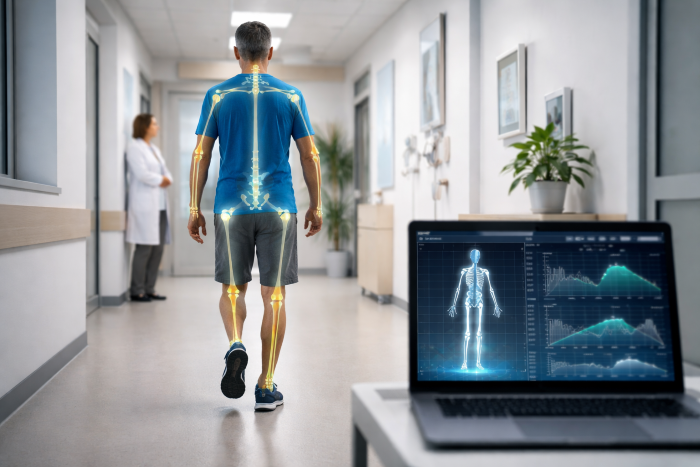
Markerless motion capture uses computer vision algorithms to estimate joint motion directly from video. In recent years, advances in deep learning and pose estimation have allowed three-dimensional joint kinematics to be reconstructed from standard camera systems.
A systematic review published in PeerJ in 2022 evaluated markerless motion capture systems and found that several platforms demonstrated acceptable agreement with marker-based systems for certain joint angle measurements, particularly in controlled environments.
If reliable kinematic data can be captured in a standard clinic space, you may be able to integrate objective motion analysis into routine assessment rather than reserving it for tertiary biomechanics labs.
What the evidence shows about accuracy
Accuracy matters if you are considering incorporating this into preoperative planning or postoperative follow-up.
Research published in 2024 reported strong correlations for hip and knee flexion-extension angles, while noting greater variability in other planes of motion.
Investigators also found that clinically meaningful gait deviations were detected consistently, with variation between testing sites remaining within ranges typically observed in conventional marker-based gait laboratories.
These findings suggest that markerless systems can produce repeatable measurements for certain applications. However, agreement varies depending on the joint, plane of motion, and specific platform used.
A key limitation: Most validation studies compare markerless systems to marker-based lab setups, not to surgical outcomes. Agreement with a lab standard does not automatically translate into better operative planning.
Where limitations may affect your practice
Although validation data is encouraging, several reviews highlight ongoing limitations.
The PeerJ systematic review noted variability in joint center estimation and differences in accuracy between sagittal and non-sagittal plane measurements. The authors emphasized that performance depends heavily on the underlying algorithms and testing conditions.
Researchers writing in Frontiers in Digital Health discussed challenges related to soft tissue artifact modeling and performance outside controlled laboratory settings. The authors concluded that while markerless systems are advancing rapidly, further validation in diverse clinical environments remains necessary.
In your clinic, lighting, clothing, camera positioning, and patient body habitus may influence measurement reliability. These variables are not always present in laboratory validation studies.
Potential clinical applications
You may see practical value in spatiotemporal parameters such as gait speed, step length, and symmetry, which tend to show stronger agreement with marker-based systems than complex multiplanar joint kinematics.
Possible applications include preoperative assessment in knee osteoarthritis, postoperative arthroplasty monitoring, and return-to-play evaluation in sports medicine. At present, most published data focus on measurement validity rather than demonstrated improvement in surgical decision-making or long-term outcomes.
That distinction is important. Objective motion data is useful only if it influences how you plan surgery or manage rehabilitation.
Adoption consideration: Validation results vary by platform, which makes independent published data essential before integrating a specific system into your workflow.
Is it ready to replace the gait lab?
Current evidence does not support replacing comprehensive gait laboratory analysis in complex deformity or neuromuscular cases. Traditional marker-based systems remain the reference standard for high-precision biomechanical modeling.
However, if you practice in a setting without access to a formal gait lab, markerless motion capture may offer a scalable way to obtain repeatable kinematic data in-house. As outcome-based research expands, you will have clearer guidance on when this technology meaningfully enhances orthopaedic care.
For now, it is best viewed as an emerging adjunct rather than a full substitute for established motion analysis platforms.