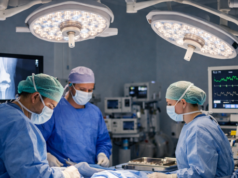
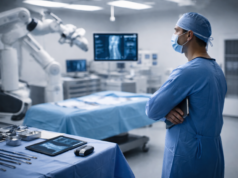
Early mobilization after spine or lower-limb surgery can improve functional outcomes and reduce complications while helping patients return to daily activities sooner. Achieving this in your patients means balancing surgical healing with safe, progressive activity. You can use exoskeletons to bridge surgical recovery and active rehabilitation. These devices can give you controlled assistance and help you enable repetition without compromising stability, especially in the early phases when patients are vulnerable to fatigue or instability.
Smart systems now integrate sensing capabilities. They offer responsive feedback and adaptable support so you can calibrate assistance in real time based on a patient’s movement quality. This technology is intended to complement, not replace, your established rehabilitation protocols. You may find it especially useful during therapy plateaus, when real-time gait data and adaptive support can encourage continued progress.
Lessons from clinical use: Pediatric and adult applications
Experiences with pediatric and adult exoskeletons offer insight for you as you evaluate their role in post-operative care.
In pediatric rehabilitation, the MyoStep soft exoskeleton from the University of Houston uses smart fabrics. It incorporates a sensor network and includes artificial muscle actuators with responsive support systems. It is lightweight, discreet, adaptable in fit, and can grow with the child to preserve muscle activation patterns during therapy.
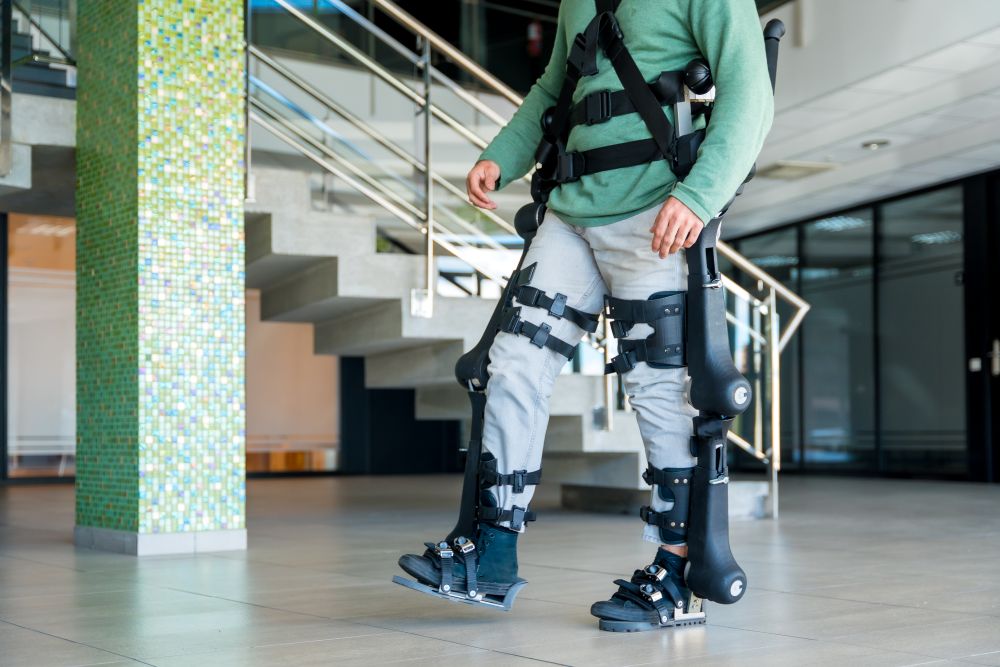
In adult rehabilitation, you may encounter the EksoNR in use for standing and walking therapy after stroke. It has been applied in spinal cord injury and acquired brain injury rehabilitation. Reports note its use in MS and other neurological conditions. It provides adjustable support and supplies gait data to therapists, giving them detailed information for treatment adjustments.
These examples show how different designs may influence your clinical approach. Soft textile systems can improve comfort while supporting higher patient compliance. Rigid powered systems can deliver structured therapy with the potential for high-intensity practice when clinically appropriate. Both can serve as reference points when you are tailoring post-operative mobility strategies to match patient needs and rehabilitation resources.
Building better tools: Innovation and design pathways
OpenExo, an open-source exoskeleton framework, offers multiple resources for development. It includes step-by-step guides for assembly. It provides code libraries with adaptable modules and offers reference designs.
A 2023 review in the Journal of NeuroEngineering and Rehabilitation highlighted several limitations of rigid exoskeletons. Safety issues and usability challenges were common findings. Excess weight was identified as another major barrier to patient adoption.
For you as an orthopaedic surgeon, these development pathways show the value of working with engineers early in the design process. Your clinical priorities, such as controlling load during use and maintaining post-operative safety, can be integrated from the outset. This collaboration can also extend to creating safety protocols that cover load control, range-of-motion limits, and device weight thresholds appropriate for your patient population.
Practical integration considerations
Introducing exoskeleton technology into your setting requires more than choosing the right model. Training your rehabilitation team in both device operation and data interpretation is essential. Staff should know how to start, stop, adjust, and recalibrate device settings while also understanding how to use gait data or movement metrics to guide treatment progression. This training can improve confidence and reduce error risk during patient sessions.
You should also establish clear scheduling practices for exoskeleton sessions. These sessions can be added to current rehabilitation programs without removing other therapy components. This approach preserves continuity of care and maximizes the benefit of additional support and data from the device.
Clinical progress monitoring should rely on measurable indicators relevant to post-operative goals. These may include walking distance, step symmetry, changes in gait speed, or the time it takes for a patient to regain independence with specific mobility tasks. Regularly reviewing these metrics will help you determine whether to increase device assistance, progress to unsupported activity, or revise rehabilitation targets.
Bringing it together in practice
Your aim in early mobilization is to support recovery that leads to strong long-term function. Exoskeleton technology, when used with clear clinical objectives, can help you achieve that aim. Pediatric and adult examples demonstrate how design choices affect comfort, therapy intensity, and overall feasibility.
Implementation should be guided by clinical evidence. You can assess patient suitability individually, considering the specific type of surgery and expected recovery trajectory. Resource availability and staffing capacity should also be considered before introducing exoskeleton therapy. Collaboration between you, rehabilitation specialists, and engineers will allow continuous refinement of technology use in line with patient outcomes and clinical efficiency.
Quick reference
- Identify patients with significant mobility limitations in the early post-operative phase.
- Match exoskeleton type to patient needs, considering comfort, adjustability, therapy intensity, and adaptability for long-term use.
- Ensure your rehabilitation team receives training on device use and data interpretation.
- Establish safety protocols for load control, weight limits, and range-of-motion restrictions.
- Incorporate exoskeleton sessions into existing rehabilitation schedules to maintain continuity of care.
- Evaluate patient progress using measurable clinical indicators and adjust device settings as recovery advances.
- Collaborate with engineers and designers to refine device features based on clinical feedback.
Disclaimer: This article is intended for informational and educational purposes for healthcare professionals. It does not replace independent judgment or institutional protocols. You should base patient care decisions on individual patient needs, current clinical guidelines, and the resources available within your setting.
Sources
Helping thousands of individuals take millions of Ekso-aided steps
Researchers launch open-source robotic exoskeleton to help people walk
Smarter, lighter exoskeletons to provide better mobility therapy